
A proper kitesurf weather forecast guide can be the difference between an epic session and a dangerous one. Understanding wind, gusts, waves, and tides allows you to make smart decisions before you even arrive at the beach.
This complete kitesurf weather forecast guide will teach you how to read forecasts like a pro, interpret wind data correctly, and identify safe conditions for your level.
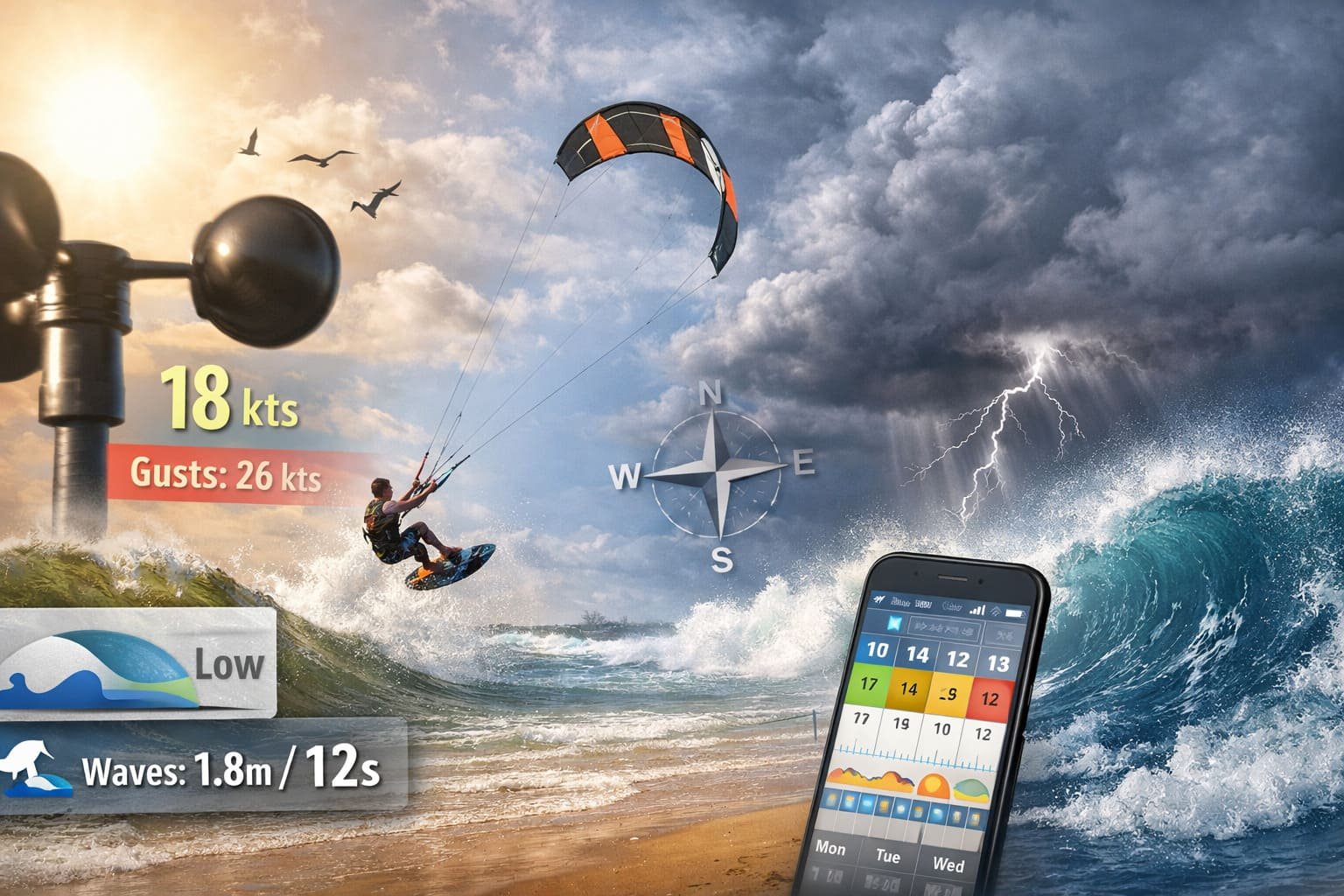
The 5 Essentials in Every Kitesurf Weather Forecast Guide
Every reliable kitesurf weather forecast guide focuses on five key elements:
- Sustained wind speed
- Wind gusts
- Wind direction
- Wave height and period
- Tides and currents
If you learn to evaluate these correctly, your sessions will be safer and more enjoyable.
Sustained Wind vs Gusts
A core part of any kitesurf weather forecast guide is understanding the difference between steady wind and gusts.
- Sustained wind is the average wind speed.
- Gusts are short bursts of stronger wind.
If a forecast shows 18 knots with gusts to 28 knots, that’s a large spread. This means conditions may feel unstable. A good kitesurf weather forecast guide always recommends checking how big that difference is before rigging.
For beginners, consistent wind is far better than gusty wind.
Wind Direction: Why It Matters
A professional kitesurf weather forecast guide always analyzes wind direction relative to the shoreline.
- Side-shore: safest and ideal for progression
- Onshore: manageable but needs awareness
- Offshore: risky, especially for beginners
When using a forecast app, always visualize the beach orientation. The smartest riders use a kitesurf weather forecast guide to choose the right spot, not just the right kite.
Waves and Swell: More Than Just Height
A complete kitesurf weather forecast guide also explains wave period.
Two days may both show 1.5m waves, but if one has a 6-second period and the other has a 14-second period, the energy is completely different.
- Short period = choppy and messy
- Long period = powerful, organized swell
Understanding this part of the kitesurf weather forecast guide helps you decide if conditions match your skill level.
Tides and Currents
Many beginners ignore tides, but an advanced kitesurf weather forecast guide always includes them.
Tide level can change:
- Water depth
- Launch area size
- Strength of currents
- Shore break intensity
Some spots only work well at mid or high tide. Before heading out, check the tide chart as part of your personal kitesurf weather forecast guide routine.
Comparing Forecast Tools
No single app is perfect. A strong kitesurf weather forecast guide recommends comparing at least two forecast sources, such as:
- Wind-based forecast apps
- Marine forecast services
- Local station readings
Models can differ. The best practice is to use your kitesurf weather forecast guide skills combined with real-time observation at the beach.
Red Flags: When Not to Go
A responsible kitesurf weather forecast guide also teaches when to stay home.
Avoid riding if:
- Storm systems are approaching
- Gust spread is extreme
- Offshore winds are strong
- Marine warnings are issued
- Lightning is in the forecast
The smartest riders know that sometimes the best decision in your kitesurf weather forecast guide is to skip the session.
Quick Checklist Before Rigging
Use this simple kitesurf weather forecast guide checklist:
✔ Check sustained wind
✔ Check gust difference
✔ Confirm wind direction
✔ Review wave height and period
✔ Look at tide timing
✔ Evaluate your skill level
If all factors align, you’re ready for a great day.
Conclusion
Mastering a kitesurf weather forecast guide is one of the most valuable skills in kiteboarding. It increases safety, improves performance, and helps you choose the right equipment for the day.
The more you practice reading forecasts, the more confident you become. Wind knowledge equals rider confidence.
Ride Smarter With Estilo de Vida
At Estilo de Vida, we don’t just teach you to ride — we teach you how to understand conditions using a proper kitesurf weather forecast guide approach.
Our instructors help you:
- Read wind forecasts correctly
- Choose the right spot
- Select proper kite size
- Progress safely